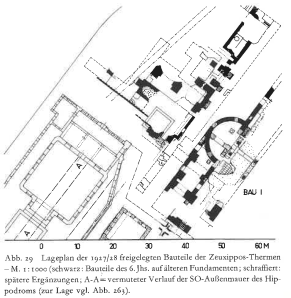
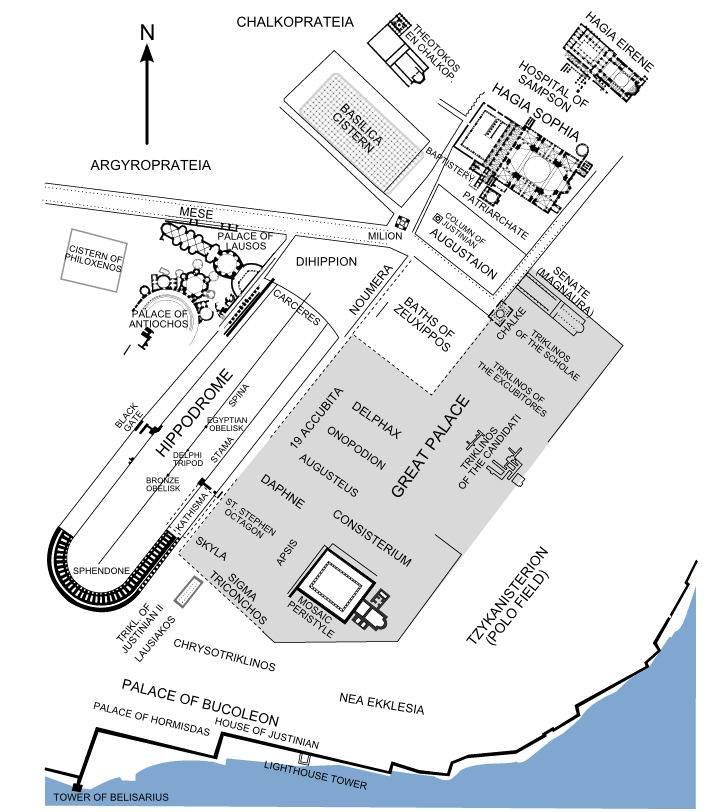
The Baths of Zeuxippos in Region II were among Constantinople’s most magnificent public baths, supplied by the lower Hadrianic line near the Imperial Palace. Excavations suggest they stood about 30 meters above sea level in the Byzantine era. Renowned for their lifelike statues—over 80 cataloged by Christodoros—the baths also featured an epigram honoring Empress Sophia, erected by the city prefect Julian. The surrounding shops and houses funded their maintenance, as mandated by a 424 edict of Theodosius II.
The baths were destroyed in the Nika riot of 532 but restored by Justinian. Later, parts of the site were repurposed for an imperial silk factory and prison. By the 10th century, the Book of Ceremonies placed them near the Chalke, separated by the Achilles Passage. Nikephoros Callistus (14th century) referred to them as the "Noumera," but by the 16th century, Gilles found no trace of the Baths of Zeuxippos remaining.