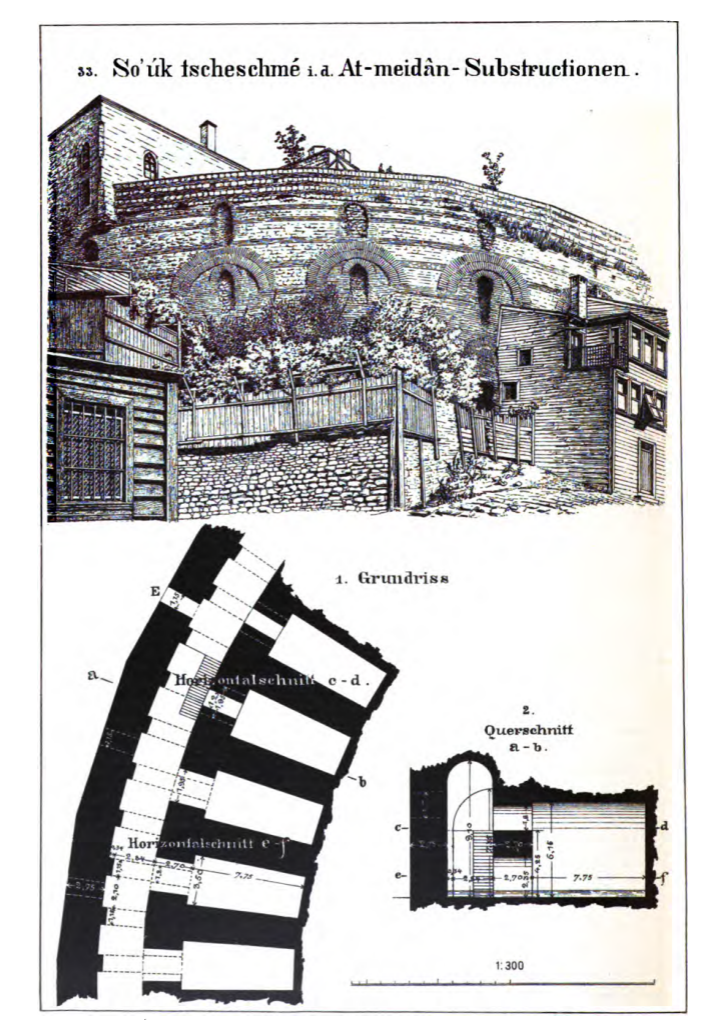
The Sphendone Cistern, also known as the "Cold Cistern of Anastasius," occupies the curved end of the Hippodrome, aligned with the Hadrianic water line. Originally built during the reign of Septimius Severus, the structure was later converted into a cistern in the Byzantine period. By the late 19th century, the Janissary Museum stood atop the Sphendone, and today, the Sultanahmet Endüstri Meslek Lisesi occupies the site. The cistern likely supplied water to a nearby Ottoman fountain and may be connected to the Nakilbent Cistern.
The Sphendone, with a diameter of 141 meters, houses the cistern in approximately three-fifths of its corridor. The semicircular structure combines pure brick in its lower sections with layered masonry above, reinforced by two rows of relieving arches and flying buttresses. The walls, about 2.75 meters thick, form trapezoidal, barrel-vaulted chambers (7.75 m × 3.50 m). A later-added staircase provides access to the water-holding section, which includes a 500-meter barrel-vaulted passage extending toward the Hippodrome’s spina. While the passage lacks plaster, some rectangular rooms within the cistern are plastered—a common Byzantine method for converting buildings into cisterns. The thick walls eliminated the need for internal columns.