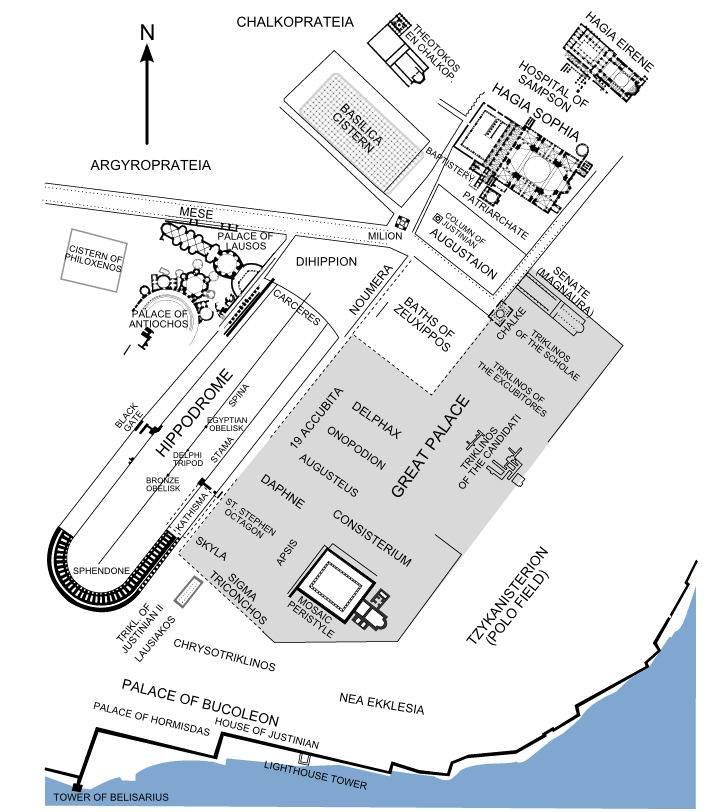
It is difficult to assess which cistern within the imperial palace this could be, partially because it remains unknown whether this cistern was open or covered. Its approximate location at the Imperial Palace suggests it was supplied by the Hadrian Waterway (see further Crow et al., 2008, p. 117, 124).
Literary evidence
Built by Justinian after the Nika riots after fearing being besieged in the palace again. Its exact location is not known, but it was part of the old Imperial Palace east of the Hippodrome. According to Crow et al., 2008, p. 17, note 39: the location of this cistern is not known with any precision.
According to Janin, 1964, p. 211, there were five(?) cisterns in the palace, amongst them the cistern referred to in Chronicon Paschale. Two of the Palace cisterns had been covered up due to Heraclius' (r. 610-641) hydrophobia; these cisterns were located in front of the Magnaaura and the other between Justinian's triklinos and Lausiakos (next to the south of the Hippodrome). They were later cleaned and restored by Basil I (r. 867-886), as they had been turned into gardens - leaving Janin to conclude that they may have been open cisterns. Janin believes that there was a closed cistern in the palace: the Cold cistern (actually in the Sphendone of the Hippodrome).
Archaeological evidence
E. Mamboury discovered a cistern left of the Sphendone, on the slope in 1913: it measures 27 × 10.50 m, with 14 columns (of which 6 were replaced); the capitals are Corinthian and it likely dates back to the 6th century.
Another small cistern with 8 columns is located near the Justinian Palace (near the Sea Walls). It once supported the grand staircase that led to the Palace qua. It was emptied by the "Sociéte des Amis de Stamboul in 1913.